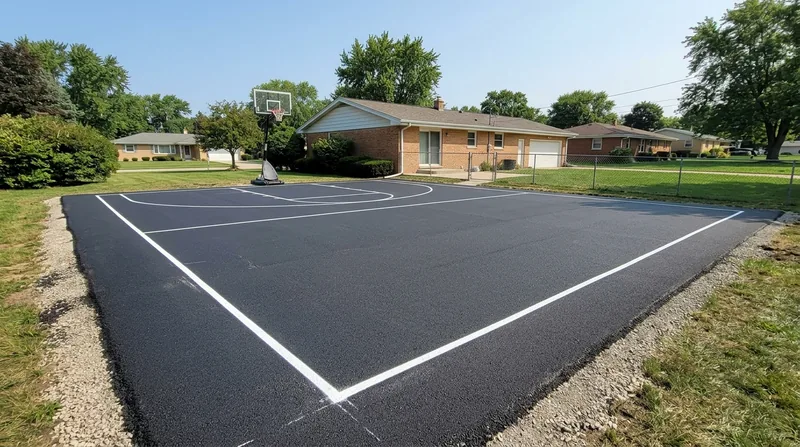




Rockford's post-war neighborhoods and newer subdivisions are built on glacial till, a clay-heavy subsoil that holds water and demands careful base preparation before any surface goes down. A backyard sports court and path paving project in Rockford faces the same frost heave pressure that breaks residential driveways every winter: a 42-inch frost line near the Wisconsin border, repeated freeze-thaw cycles, and a long northern Illinois winter that will exploit any weak point in the base. Unlike a driveway that carries occasional weight, a basketball or tennis court needs a stiffer, thicker compacted foundation and precise pitch for drainage to resist the heave that cracks and buckles playing surfaces. We build courts and paths that stay flat and playable through ten years of Rockford winters, with a base thick enough to handle the clay-till ground and the frost line that defines this region.
Why Sports Court and Path Paving Matters in Rockford's Climate
Rockford's climate and soil conditions create specific challenges for recreational surfaces. The clay subsoil under most of Rockford, Loves Park, and Cherry Valley holds moisture and expands when frozen, a process called frost heave that lifts and cracks any surface without a properly compacted base beneath it. A driveway can sometimes tolerate a thinner base, but a court or path used for sports demands consistency: uneven surfaces cause ankle injuries, bouncing balls go unpredictably, and a buckled court becomes unsafe. The freeze-thaw cycle that dominates this region, driven by the deep frost line, is the single largest threat to court longevity.
- We install a thicker compacted base, typically 6 to 8 inches of properly graded aggregate, far exceeding what a standard driveway requires.
- Drainage pitch is built into the subgrade so water does not pool under the asphalt, which would accelerate freeze-thaw damage.
- The asphalt itself is laid in two courses, binder and surface, to create a smooth, consistent playing plane that resists cracking under repeated impact.
- We proof-roll the base after compaction to confirm it will hold weight and not shift during the first winter.
These steps keep a court playable and safe for years, even on Rockford's demanding clay-till ground.
Key info: Rockford's frost line sits near 42 inches, close to the Wisconsin border. A court built without a proper base will heave and crack within the first winter. The cost difference between a thin base and a frost-proof one is small; the cost of repairing a buckled court is large.
How We Build Sports Courts and Paths in Rockford: The Process
Every court and path job starts with a site visit to measure the area, assess drainage, and understand the existing ground. Rockford's terrain is generally flat, but water pooling is a real issue on clay till, so we design the pitch and base layout before we break ground. We clear and grade the area, bring in compacted aggregate base, and lay the asphalt in two courses. The result is a smooth, durable surface that handles freeze-thaw stress and stays flat for play.
- We measure the court or path and mark out the boundaries and any line work you need (court lines for basketball or tennis are marked after the asphalt cures).
- We remove any existing surface or soft soil and grade the subbase to a slight pitch, typically 1.5 to 2 percent, to shed water away from the court.
- We bring in and compact aggregate base material in lifts, proof-rolling after each lift to confirm density and bearing capacity.
- We lay the binder course, a coarser asphalt layer that bonds to the base, then the surface course, a finer mix that creates the smooth finish.
- The court is ready for light use after 48 hours, but full cure (when it will handle peak impact and heat) takes 30 to 60 days depending on weather.
For residential courts in neighborhoods like the East Side, West Side, or Cherry Valley subdivisions, we coordinate with your HOA if rules require it and verify any local permits with your village before we start.
Example: A 2,400-square-foot basketball court in Loves Park on clay-heavy ground typically needs a 6-inch compacted base, two courses of asphalt, and proper drainage pitch. The job takes 3 to 5 days from site prep through asphalt placement, depending on weather and base conditions.
For more information on how base preparation affects all asphalt surfaces, see our page on asphalt driveway paving and installation.
Court and Path Paving Methods
| Approach | Description | Best for |
|---|---|---|
| New Court Construction | Full site prep, 6 to 8 inch compacted base, two-course asphalt, drainage pitch, finished smooth. | Backyard courts on raw ground or over existing failed surfaces; residential or small commercial. |
| Path or Walkway Paving | Narrower surfaces (3 to 8 feet wide) with 4 to 5 inch base and single or two-course asphalt, pitched for drainage. | Connecting courts to houses, walking paths through yards, or access routes in subdivisions. |
| Resurfacing an Existing Court | Mill off old asphalt, inspect and repair base, lay new surface course over sound base. | Courts 10 to 15 years old with surface cracks but sound base; extends life 7 to 10 more years. |
| Base Repair and Overlay | Partial base reconstruction where heave or settling has occurred, then new asphalt overlay. | Courts with isolated frost heave or soft spots in the base; avoids full removal and saves cost. |
Sports Court and Path Paving Cost in Rockford: What to Expect
A new backyard basketball or tennis court in Rockford runs from $8,500 upward, depending primarily on size, existing ground conditions, and drainage requirements. A 2,400-square-foot court on flat clay-till ground with standard base prep and two-course asphalt typically lands in the $9,000 to $12,000 range. Paths are priced by the linear foot, usually $40 to $60 per running foot for a 4-foot-wide path with proper base and asphalt. What moves the price most is the condition of the ground: clay that holds water and needs extra base material, or soft soil that requires more compaction and proof-rolling, will add cost compared to well-drained ground.
The best way to know what your court will cost is to request a free estimate. We visit your site, measure, assess the soil and drainage, and give you a detailed quote with tonnage and base thickness spelled out. Two or three estimates from different contractors will also show you the range and help you understand what drives the price on your specific ground.
See our full pricing page for additional detail on base prep, asphalt courses, and how soil conditions affect the final cost.
Sports Court and Path Paving Near Me: What Rockford Homeowners Should Know Before Hiring
Hiring a paving contractor for a court or path is a straightforward decision if you know what to look for. Start by asking any contractor for proof of insurance (fully insured is the standard credential in this trade). If your village or HOA requires a permit or has architectural standards for court construction, confirm that the contractor understands those rules before you hire. In Rockford and surrounding areas, some municipalities require permits for impervious surfaces or driveway aprons; check with your village building department or HOA before work begins. Getting two or three estimates is smart, and comparing them means asking each contractor the same questions: base thickness in inches, tonnage of asphalt, whether they proof-roll the base, and how long the surface will cure before you can use it.
- Verify insurance and ask for a certificate of insurance before any work starts.
- Confirm with your village or HOA that no permit is required, or help obtain one if it is.
- Get a written estimate that includes base thickness, asphalt tonnage, and the number of courses being laid.
- Ask for references from recent court or path jobs in Rockford or nearby areas, and follow up with at least one.
- Understand that new asphalt takes 30 to 60 days to fully cure; avoid heavy impact or parking on the surface during that time.
The most important step is to work with a contractor who is local, fully insured, and willing to explain their base prep and drainage plan before you sign. Contact us to discuss your court or path project and get a free estimate with no obligation.
Sports Court & Path Paving in Rockford: Pricing Guide
| Service | Price | Details |
|---|---|---|
| Basketball or Tennis Court (2,400 sq ft) | Starting at $8,500 | Full site prep, 6-inch compacted base, two-course asphalt, drainage pitch, finished smooth, clay-till ground |
| Path or Walkway (per linear foot, 4 ft wide) | Starting at $40 to $60 | 4 to 5 inch compacted base, two-course asphalt, pitched for drainage, includes site prep and compaction |
| Base Repair and Overlay (existing court) | On estimate | Scope depends on heave damage, soft spots, and base condition; site visit required to assess repair depth and cost |
| Large or Complex Court (3,000+ sq ft, poor drainage) | On estimate | Extra base material, enhanced drainage, difficult site access, or soil remediation require on-site evaluation |
| Travel and Site Visit | Included | No extra charge in Rockford and surrounding service areas; mileage is part of the estimate |
| Free Estimate | Free | Detailed site visit, measurement, and written quote with base specs and tonnage; response within 24 hours at (815) 706-5982 |
Indicative pricing, the exact cost depends on square footage, finish, and site access. Free personalized estimate within 24h at (815) 706-5982.


